
Bengaluru: As climate change accelerates across the globe, nations are increasingly facing the consequences of rising temperatures, unpredictable weather patterns, water scarcity, biodiversity loss, and environmental degradation. According to global climate assessments, the world is witnessing record-breaking heatwaves, extreme rainfall events, and growing pressure on natural resources, underscoring the urgent need for collective action toward sustainability and conservation.
Against this backdrop, the Climate Innovation Summit 2026 at IIM Bangalore brought together policymakers, scientists, innovators, environmentalists, and industry leaders to discuss practical solutions for building a climate-resilient future. Among the summit’s most memorable moments was an address by Group Captain Shubhanshu Shukla, India’s first astronaut to visit the International Space Station (ISS), the second Indian in space after Rakesh Sharma’s historic 1984 mission, and pilot of the landmark Axiom Mission 4.
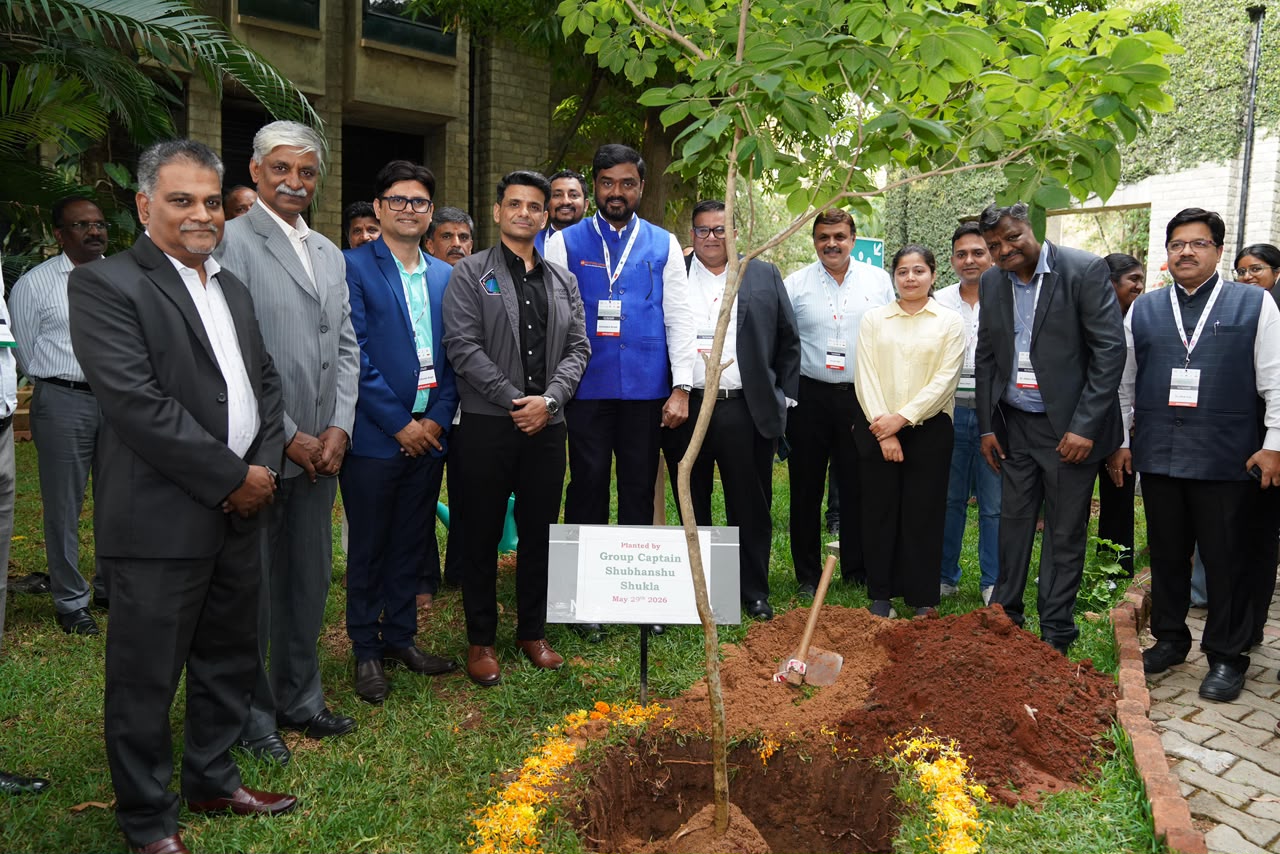
Before addressing the audience, Group Captain Shubhanshu Shukla planted a tree, a symbolic gesture that reflected the summit’s broader message of environmental responsibility. The act resonated deeply with attendees, serving as a reminder that addressing global climate challenges begins with simple yet meaningful actions on the ground.
Drawing upon his extraordinary experience in space, Group Captain Shubhanshu Shukla shared lessons learned during his 20 days, 2 hours and 59 minutes aboard the International Space Station, where he conducted more than 60 microgravity experiments. He highlighted how every resource in space is carefully managed, recycled, and reused because survival depends on efficiency.
“In space, your yesterday’s coffee is your tomorrow’s coffee,” he remarked, illustrating how sustainability is not an option in space but a necessity. His statement drew attention to the contrast between resource management aboard a spacecraft and the often-wasteful consumption patterns seen on Earth.
He emphasized that humanity’s pursuit of space exploration has consistently driven innovation in technology, material science, and resource optimization. According to him, these lessons have direct relevance for life on Earth, where sustainable practices are becoming increasingly critical for future generations.
The audience listened attentively as he reflected on Earth’s uniqueness within the vast expanse of the universe. “In this entire galaxy, there is no other planet like Earth. Yet here we are—wasting, almost abusing, every resource we have been given, disconnected from the generations who must inherit this world. When you are in space, the Earth looks like heaven. And here, living on this heavenly planet, we keep searching for heaven elsewhere,” he said.
During his address, Group Captain Shubhanshu Shukla also praised the Green India Challenge, a citizen-led environmental movement spearheaded by Igniting Minds Organisation. The initiative has mobilized the plantation of over 196 million trees and engaged more than 44 million citizens across India, making it one of the country’s largest public participation campaigns for environmental conservation.
He acknowledged the initiative as an example of how grassroots action can complement larger climate goals, encouraging individuals and communities to take ownership of protecting natural resources and restoring ecological balance.
His message reinforced a central theme of the summit: that climate action is not solely the responsibility of governments or institutions but requires participation from every citizen. The responsibility to conserve water, reduce waste, protect forests, and restore ecosystems ultimately lies with society as a whole.
As discussions at the Climate Innovation Summit 2026 focused on innovation and sustainability, the astronaut’s perspective offered a rare and powerful reminder of Earth’s fragility. Having witnessed the planet from nearly 400 kilometres above its surface, his message was both simple and profound—that while humanity continues to explore the stars, its greatest responsibility remains safeguarding the only known world capable of sustaining life.
The summit concluded with a renewed commitment to environmental stewardship and collective action. The symbolic planting of a tree and the lessons drawn from space served as a powerful reminder that the future of the planet depends not only on technological advancement but also on humanity’s willingness to value and protect the resources it already possesses.
The message was clear: Earth is not merely a resource to be consumed—it is humanity’s only home, and its preservation is among the most important missions of our time.
